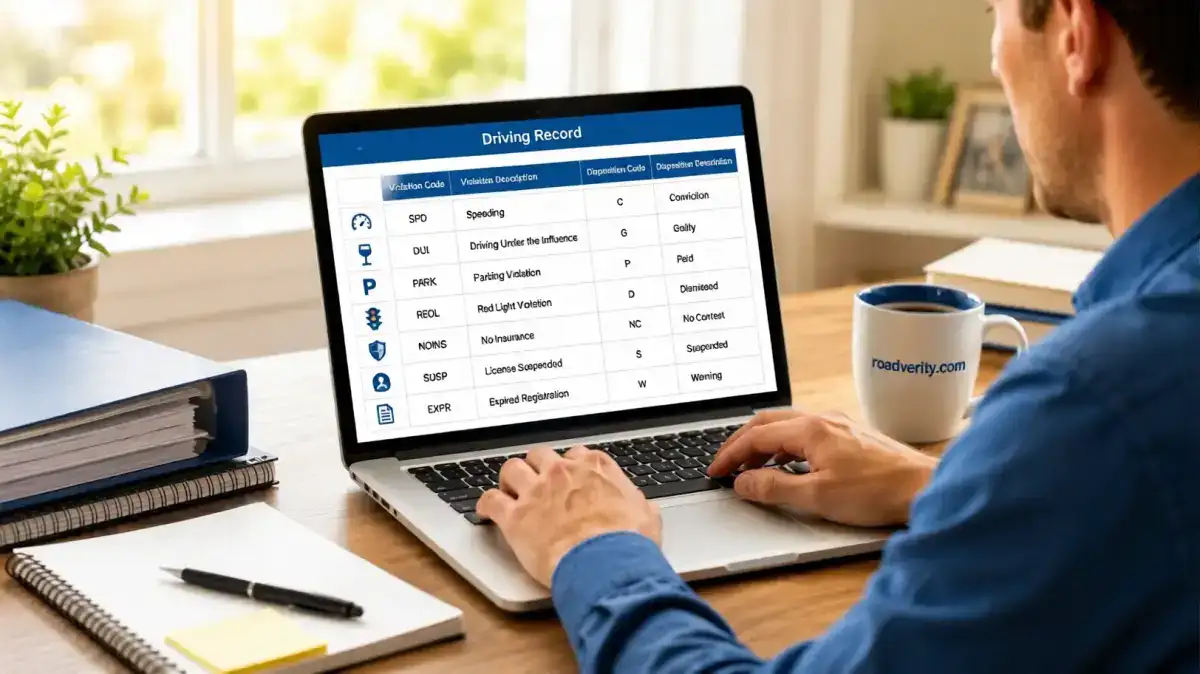
Our guide to reading a driving record covers the overall structure. This one goes deeper on the part that trips people up most: the codes themselves — where they actually come from, why the same violation can look completely different on two different records, and how to find the specific list for your state.
Two Different Kinds of Codes on Your Record
Most driving records actually mix two separate coding systems, and knowing which is which explains a lot of the confusion:
- Your state's own violation codes, tied directly to that state's specific traffic laws and statute numbers. This is what you'll see for the vast majority of entries — violations that happened in your home state.
- AAMVA Code Dictionary (ACD) codes, a standardized set used specifically to report a violation from one state to another — for example, a ticket you received while driving through a different state, which then gets reported back to your home state's record.
Vermont's own DMV describes this distinction clearly: an ACD code appears on a Vermont record specifically when a violation has been reported to Vermont from another jurisdiction — not for violations that happened in Vermont itself, which use Vermont's own code list instead.
What an ACD Code Actually Looks Like
ACD codes follow a consistent format: one letter followed by two numbers. As a published example, the code "S15" stands for speeding 15 miles per hour or more above the posted or regulated limit. Codes are organized into categories — speeding violations and alcohol/drug violations are two examples — which is why you'll often see a related group of letters (like several "S" codes) covering different speed thresholds. The full dictionary is maintained and copyrighted by AAMVA itself, so we won't reproduce it here, but it's worth knowing the shape of it so an unfamiliar code doesn't look like a random string.
Why These Codes Exist in the First Place
The ACD system grew out of federal commercial-driver-safety law. States needed a way to reliably tell each other about a commercial driver's convictions and license actions, even though every state's own traffic code uses different numbering and language. AAMVA's dictionary functions as a translation layer between states, and it also feeds two federal systems: CDLIS (Commercial Driver's License Information System) and PDPS (the Problem Driver Pointer System) — the same system referenced in how out-of-state records get flagged when you move. It exists to solve a coordination problem between states, not to replace each state's own record-keeping.
Disposition Codes Are a Different Thing Than Violation Codes
It's easy to conflate these, but they answer different questions. A violation code identifies what happened — the specific offense. A disposition — sometimes also coded, sometimes spelled out — identifies what happened in court afterward: convicted, dismissed, deferred, or another outcome specific to that state. The same violation code can appear on two different people's records with two completely different dispositions attached, which is exactly why disposition matters as much as the violation itself when someone is evaluating your record.
Why the Same Violation Can Look Different on Different Reports
If you've ever compared your official state record to a version pulled by an employer's background-check provider, you may have noticed the codes don't match. That's normal, and it happens because up to three separate coding layers can be involved: your state's own code, an ACD code if the violation involved another state, and a background-check company's own internal lookup code that maps to both of the others for their processing purposes. None of these is "wrong" — they're just different systems describing the same underlying event.
How to Find Your State's Actual Code List
Many states publish their own violation code list directly — Vermont, for example, maintains a public alphabetical listing with the statute reference, points assessed, and a plain-language description for each code. Search "[your state] DMV violation codes" or check your state's motor vehicle agency site directly; if you can't find a published list, a call to the agency is more reliable than guessing based on a code you've seen elsewhere.
Frequently Asked Questions
If I see an unfamiliar code, does it definitely mean something serious?
Not necessarily — code format alone doesn't indicate severity. Look up the specific code or contact the issuing agency rather than assuming based on how unfamiliar or official-looking it appears.
Why does my out-of-state ticket show a different code than what the officer wrote on the citation?
The citation reflects the issuing state's own code. Once that conviction is reported back to your home state, it may be translated into an ACD code for that transmission, which can look different from the original citation.
Do disposition codes affect my point total the same way violation codes do?
Points are generally tied to the violation and the outcome together — a dismissed citation typically doesn't add points even though the violation itself might have carried some had it resulted in a conviction.
Can I look up what an ACD code means myself?
The full ACD dictionary is AAMVA's copyrighted material and isn't freely published in full, but many background-check and driver-record companies maintain lookup tools for common codes, and your state's own DMV can tell you what a specific code on your record means.
Sources & Methodology
Compiled from AAMVA's own published materials and state motor vehicle agency sources:
The ACD code set is AAMVA's copyrighted material; this article describes its structure and purpose rather than reproducing the dictionary itself. State-specific violation codes are set independently by each state and can change. This guide reflects information current as of publication — confirm an unfamiliar code with your state's motor vehicle agency directly.
This article is for general educational purposes only and isn't legal advice. For guidance on your specific situation, contact your state's motor vehicle agency directly.
Next step: Commercial drivers see additional codes tied to CDLIS and federal qualification rules that don't appear on a standard record. See CDL Driving Records for what's different.


Leave a Reply