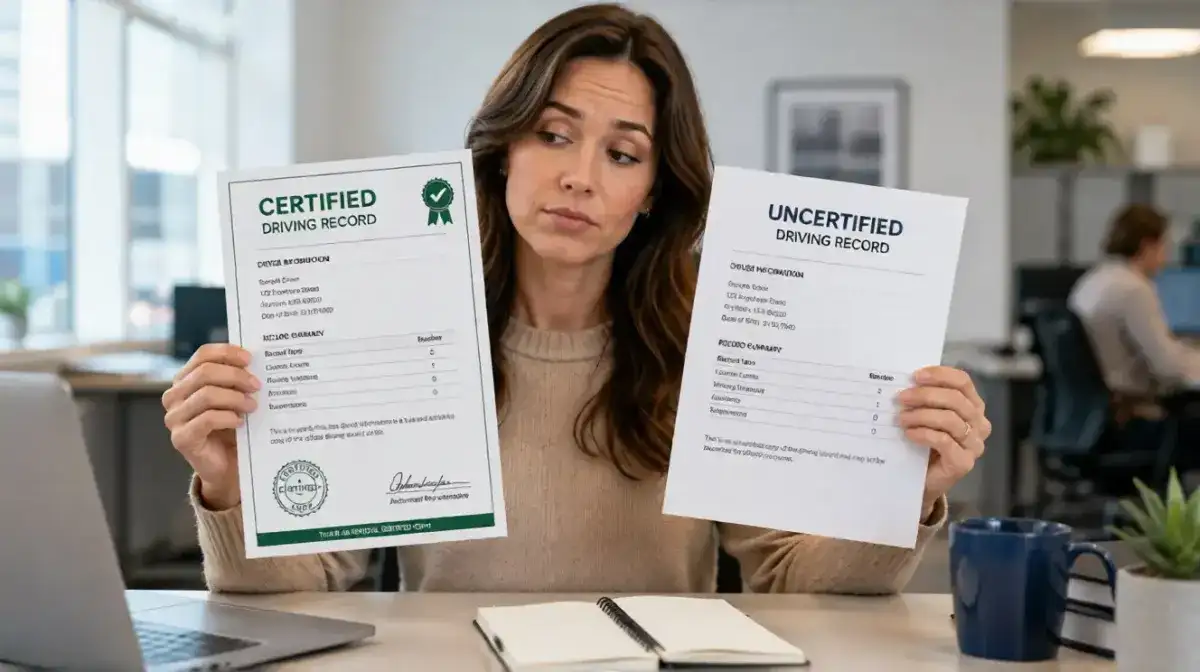
When you request your driving record, many states let you choose between a certified and an uncertified copy — and picking the wrong one is one of the most common, most avoidable mistakes people make. The two documents usually show the exact same information. What's different is whether the person or agency asking for it will actually accept it. If you haven't requested your record yet, start with our guide on how to get your driving record. If you're just trying to figure out which version to order, here's exactly how to tell.
What Is an Uncertified Driving Record?
An uncertified (sometimes called "non-certified") driving record is an informal copy of your driving history. It shows the same violations, points, and license status as the certified version, but it carries no official seal, stamp, or statement from the state confirming it as an authentic government record. It's meant for personal use — checking your own point total, reviewing your license status, or spotting an error before it becomes a problem. In states that offer online requests, you can typically generate one instantly.
What Is a Certified Driving Record?
A certified driving record carries an official stamp, seal, or signed statement from your state's motor vehicle agency, attesting that it's a true and accurate copy taken directly from the state's own system. That certification is what makes it acceptable for legal and official purposes. Courts, licensing boards, and certain government purposes often require it specifically because an uncertified copy can't be verified as authentic on its own — though not every employer or agency needs a certified copy by default; it depends on the specific purpose.
Why the Difference Actually Matters
The two documents generally report the same underlying information, but only the certified version is accepted in most of the situations below:
- Courts: many state and local courts won't accept an uncertified copy as evidence in a traffic or criminal case — you may be turned away and told to come back with a certified one.
- Commercial driving jobs: federal regulations (49 CFR §391.25) require motor carriers to obtain and review a Motor Vehicle Record for each commercial driver at hire and annually after that. The regulation itself doesn't specify a certified copy — current FMCSA guidance confirms carriers may satisfy this requirement through third-party systems as well as records pulled directly from the state. Many carriers use certified copies anyway for their own audit trail, but it isn't a blanket federal mandate. See MVR vs. Driving Record: What Employers Need to Know for the full employer-side breakdown.
- Out-of-state license transfers: some states require a certified copy from your previous state before issuing a new license.
- Insurance or legal disputes: if your driving history is being used as evidence — in a dispute over a rate increase, for example — a certified copy carries more weight than an uncertified one.
- Personal review: for simply checking your own record, an uncertified copy is completely fine, and it's usually cheaper or free.
Certified vs. Uncertified at a Glance
| Uncertified | Certified | |
|---|---|---|
| Contains | Same violation, point, and license info | Same violation, point, and license info |
| Official seal or stamp | No | Yes |
| Accepted by courts | Usually not | Usually yes |
| Preferred for commercial (CDL) employment files | Not typically | Common practice, though not a strict federal mandate |
| Typical cost | Lower, often the base fee | Same or a few dollars more |
| How to get it | Usually available online, instantly | Varies by state — some offer it online, others require mail or in person |
| Best for | Personal review | Courts, employers, licensing boards, other state DMVs |
How to Know Which One You Need
- Just want to check your own points or license status? — Uncertified
- Applying for a job that requires a background check, especially a commercial driving role? — Certified (confirm the exact requirement with the employer or HR)
- Headed to traffic court or a license hearing? — Certified
- Transferring your license to a new state? — Check with the new state's DMV; many require certified
- Shopping for insurance or checking your own rate? — Uncertified is usually enough; your insurer pulls its own record regardless
If you're ordering on someone else's behalf — an employer, an attorney, an insurer — always ask them directly which type they need before you pay for the wrong one.
How to Request a Certified Copy
Availability varies significantly by state. Some states, like the District of Columbia, offer both certified and uncertified copies without restricting certified requests to mail or in-person only. Others, like California, provide an online driver-record printout that isn't certified — getting a certified copy there specifically requires mailing a separate form. Because this varies so much, check your own state's DMV website before assuming the online option will give you a certified copy. See our general request guide for the standard process, and fees and processing times by state for state-specific certified-copy pricing.
Common Mistakes to Avoid
- Ordering the cheaper uncertified copy for something that specifically required certified, then having to pay again and wait for a second request
- Assuming every state's online system offers a certified option — many don't
- Waiting until the deadline to request a certified copy by mail, when it can take one to three weeks to arrive
- Not asking the requesting party — employer, court, DMV — exactly which type they need before ordering
Frequently Asked Questions
Do certified and uncertified records show the same violations?
Generally, yes — certification is a statement about the document's authenticity, not a difference in what it reports. If completeness matters for your specific situation, it's worth confirming directly with the issuing agency, since exact record contents can vary by state and request type.
Is a certified copy always more expensive?
Often, but not dramatically — many states charge a few dollars more for certification, while some charge the same fee regardless of type. Exact pricing varies by state; see our fees-by-state guide for specifics.
Can I upgrade an uncertified copy to certified later?
No. You'll need to submit a new request specifically for a certified copy — there's no way to add certification to a document you already have.
Does a certified driving record expire?
Most requesting parties want a record that's recent — often within 30 to 90 days of the date they receive it — rather than one with a formal expiration date. Check with whoever is requesting it for their specific age requirement.
Sources & Methodology
This guide was compiled from federal motor carrier safety regulations and official state motor vehicle agency procedures, including:
- eCFR — 49 CFR Part 391, Qualifications of Drivers
- DC DMV — Driver Records
- California DMV — Records Requests
- American Association of Motor Vehicle Administrators (AAMVA)
Certified-copy availability, processing channels, and fees are set independently by each state and change periodically. This guide reflects information current as of publication — always confirm current requirements on your own state's official DMV, BMV, or DPS website, or with whoever is requesting the record, before submitting.
This article is for general educational purposes only and isn't legal advice. For guidance on your specific situation, contact your state's motor vehicle agency directly or consult a licensed attorney.
Next step: Once you've got the right copy in hand, it's worth knowing what to do if something on it looks wrong. See How to Correct Errors on Your DMV Driving Record.


Leave a Reply