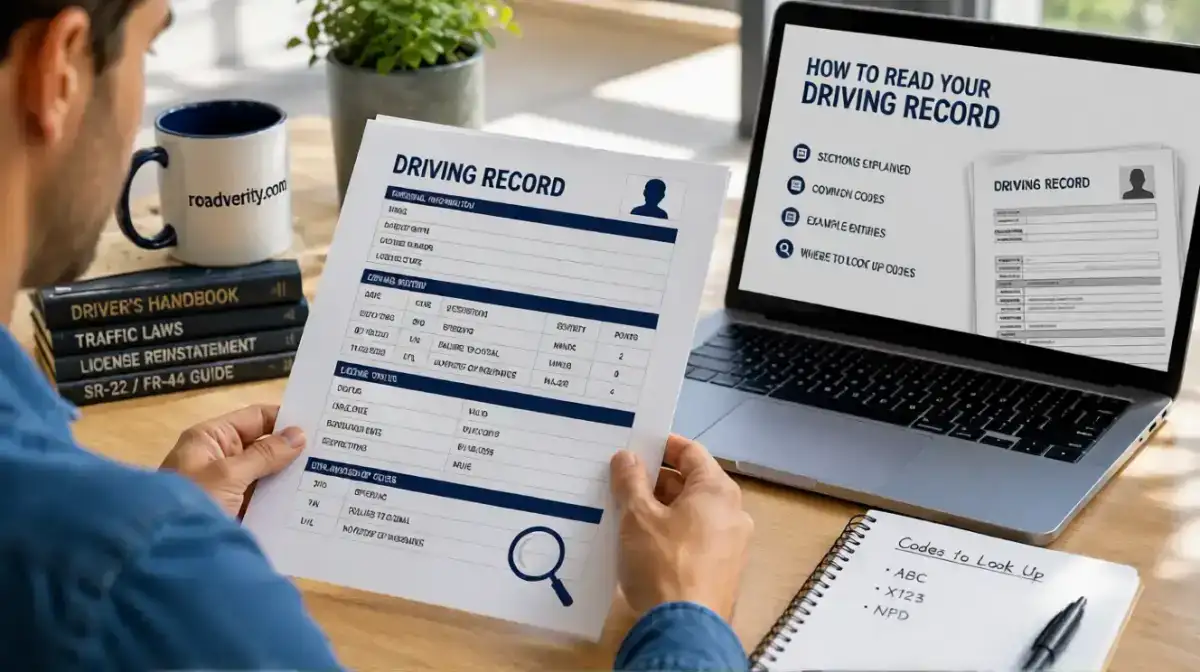
The first time you open your own driving record, it can look like a wall of abbreviations — VIOL, CONV, ACD, PT, and codes that mean nothing without a key. The good news: most states organize this information the same general way, even though the exact codes differ. Here's how to actually read it.
The Sections Every Driving Record Has
Formats differ by state, but most driving records are built from the same core sections:
- Personal and license information: your name, date of birth, license number, license class, endorsements, and any restrictions (corrective lenses, daylight-only driving, and similar).
- License status: whether your license is currently valid, suspended, revoked, expired, or conditional, along with effective dates and, if applicable, what's required to reinstate it.
- Violation and accident history: the actual list of citations, convictions, and accidents on file, each with its own date, code, and outcome.
- Suspensions, revocations, and reinstatements: a separate section showing any actions taken against your license, with an order date, effective date, and — if you're eligible to get your license back — a clear date.
How to Read a Single Violation Entry
Within the violation history, each entry typically breaks down into a consistent set of fields, even though the exact labels vary by state or by the company formatting the report:
- Violation date: when the incident happened — often shown separately from the conviction date, sometimes months apart.
- Code: a short code identifying the type of violation, referencing the specific vehicle code section it falls under.
- Description: a plain-text summary of the violation (many records only show the code and expect you to look up what it means).
- Disposition: the outcome — convicted, dismissed, deferred, or another status specific to that state's court system.
- Points: how many points, if any, the violation added, in states that use a point system.
Common Disposition Terms
"Disposition" is simply the legal outcome of a citation, and the exact terms vary by state — but a few show up often enough to be worth knowing:
- Guilty / Convicted: found guilty of the violation, whether by court decision or by paying the fine (which often counts as an admission).
- Dismissed: the citation was thrown out and shouldn't affect your record or points.
- Deferred adjudication: the conviction is held pending a probation-style period; complete it successfully and the charge may not become a formal conviction.
- Forfeiture: in states that use this term, it means someone posted bond to guarantee a court appearance and then didn't show up, forfeiting that bond.
Some states use their own additional terms beyond these — Florida, for example, also uses "Estreature" (bond posted, but the person didn't appear) and "Adjudicated Delinquent" (a juvenile finding equivalent to a criminal offense for an adult). If a term on your record isn't self-explanatory, don't guess at what it means for your license or insurance — check your state's definitions or ask the issuing agency directly.
Where the Codes Actually Come From
Many states base their violation codes loosely on a standardized system maintained by the American Association of Motor Vehicle Administrators (AAMVA), which exists specifically to make records more consistent across states. In practice, though, each state still attaches its own unique set of codes on top of that standard, and background-check companies sometimes layer a third set of internal lookup codes over both. The result: a code that means one thing in one state's record may not mean the same thing elsewhere, even when the underlying violation is similar. See Driving Record Violation & Disposition Codes Explained for a deeper look at how these codes are structured and where to find your specific state's key.
A Real Example: California's Record-Status Codes
To show what this looks like in practice: California's DMV publishes a specific set of "suspense reason" codes that can appear when a record is flagged for review — for example, code 4 means a lien sale is involved, code 5 means a dishonored check, and code 8 means a parking violation or toll evasion issue. These are published directly by the DMV specifically so record-holders and requesters can look them up rather than guess. Most states maintain something similar for their own violation and status codes, even when it isn't always easy to find on their website.
What "License Status" Entries Usually Mean
- Valid: your license is currently active and in good standing.
- Suspended: driving privileges are temporarily withdrawn, usually with a specific reinstatement path.
- Revoked: privileges are withdrawn more permanently; getting a license back typically means reapplying rather than simply reinstating.
- Conditional / Restricted: you can drive, but only under specific limits — commonly work-only or daylight-only driving.
- Cancelled: the DMV terminated the license for an administrative reason, such as a failed identity verification, rather than as a punishment for a violation.
If your record shows anything other than "valid" and you weren't expecting it, that's worth following up on immediately — it can mean an unresolved ticket, an unpaid fee, or an error you'll want to catch early. See How to Correct Errors on Your DMV Driving Record if something looks wrong.
If You Can't Decode Something
Don't assume based on a code that looks similar to one you've seen before — codes aren't standardized enough across states to guess safely. Your state's DMV, BMV, or DPS website typically publishes its own code list or glossary; if you can't find it, a call to the agency directly is more reliable than a generic guide (including this one) for a code specific to your state.
Frequently Asked Questions
Why does my record show a violation date and a separate conviction date?
Because the two often happen months apart — the violation date is when the incident occurred, and the conviction date is when the court case (or a paid fine, in states where that counts as an admission) was resolved.
Do accident entries always show who was at fault?
Not always. Some states note fault determination on the record; others simply log that an accident occurred and was reported, without an at-fault finding.
Is a dismissed citation still visible on my record?
Often, yes — it may still appear as an entry, just with "dismissed" as the disposition rather than a conviction. Whether it affects insurance or employment decisions typically depends on how the requester's own policy treats dismissed entries, not on whether it's visible.
Why do commercial driving records show extra fields I don't recognize?
CDL-specific records often include a medical certification section — certificate type, issue date, and effective date — required for commercial drivers under federal regulations, on top of the standard sections everyone else's record has.
Sources & Methodology
Compiled from official state motor vehicle agency publications and driving-record industry references:
- California DMV — Suspense Reason Codes
- California DMV — Retention of Driver Record Information
- Florida FLHSMV — Driving Records FAQ
- American Association of Motor Vehicle Administrators (AAMVA)
Exact codes, disposition terms, and record formatting are set independently by each state and can change. This guide explains the general structure using specific states as examples, not a complete code key for every state — always confirm an unfamiliar code with the issuing agency.
This article is for general educational purposes only and isn't legal advice. For guidance on your specific situation, contact your state's motor vehicle agency directly.
Next step: Want the fuller picture on how violation and disposition codes are structured, state by state? See Driving Record Violation & Disposition Codes Explained.



Leave a Reply