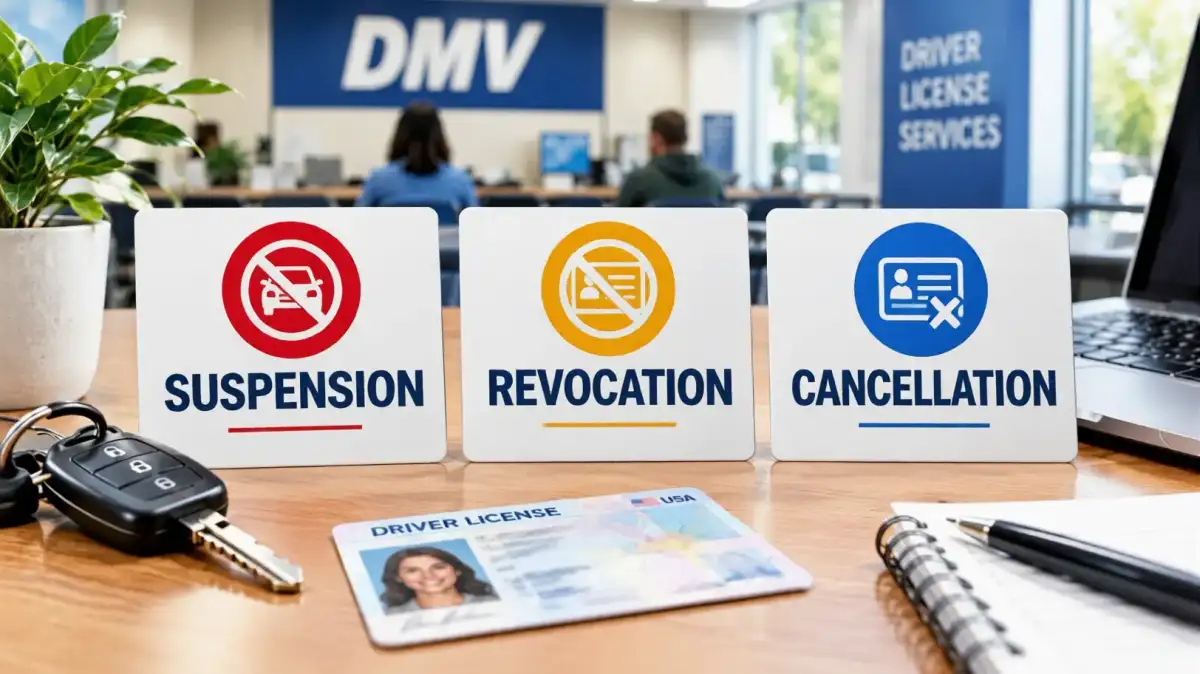
These three words get used interchangeably all the time, including sometimes on the notices that use them. They aren't the same thing, and which one actually applies to you determines whether you're waiting out a period, reapplying from scratch, or dealing with something else entirely.
Suspension: Temporary, and It Ends on Its Own
A suspension is a temporary withdrawal of your driving privileges. Your license itself isn't destroyed or voided — it's on hold. Once the suspension period ends and you've met any required conditions (paying a fee, completing a program, resolving whatever triggered it), your privileges are typically restored automatically or through a straightforward reinstatement request, without having to reapply as a new driver.
Revocation: Termination, and You Start Over
A revocation is more serious: it's a full termination of your driving privileges, not a pause. After a revocation period ends, you generally don't just get your license back — you have to apply for a new one, which can mean retaking the written and road tests and demonstrating that you're fit to drive again. Some states can deny that reapplication if your record shows you're a high risk. Revocations are typically reserved for the most serious offenses or repeat violations, and the underlying license is treated as though it no longer exists once revoked.
Cancellation: The One Most People Don't Know About
Cancellation is a different action entirely, and it isn't necessarily a punishment for something you did while driving. Under Maryland law, for example, a cancellation voids a license as if it had never been issued in the first place — typically used when the agency discovers the license was obtained based on incorrect or incomplete information, such as an undisclosed suspension from another state. The distinction that matters: suspension and revocation generally respond to something that happened after you had a valid license; cancellation is usually about a problem with how the license was issued to begin with.
A Real Example: How Maryland Draws the Lines
Maryland's rules show how specific this gets in practice. Under Md. Code, Transportation § 16-208, revocation carries an escalating minimum waiting period — six months for a first revocation, up to two years for a fourth or subsequent one. One detail worth knowing regardless of which state you're in: the waiting-period clock typically starts on whichever comes later — the date you actually surrender the physical license, or the revocation's effective date. Holding onto the physical license, thinking you're preserving something, can actually delay when your waiting period even begins. Cancellation, separately, falls under § 16-201 in Maryland and applies specifically when the license was invalid from the start.
Why the Difference Matters for What You Do Next
What you actually need to do depends entirely on which of the three applies to you:
- Suspended: wait out the period and complete any required conditions, then reinstate — see how to reinstate a suspended license.
- Revoked: wait out the minimum period, then apply as though you're a new driver, which may include retesting.
- Cancelled: the fix depends entirely on what made the license invalid in the first place — there's no single standard process, since the cause varies so much.
The Terms Can Blur, Even on Official Notices
Even state DMVs aren't always perfectly consistent with this language — New York's own DMV materials describe a revocation as meaning your license "has been canceled," using the everyday sense of the word rather than the specific legal category. Don't assume based on informal wording alone; read your specific notice carefully, or check with your state's motor vehicle agency directly, since the exact term used determines the process you need to follow.
Frequently Asked Questions
Can a suspension turn into a revocation?
In some circumstances, yes — for example, if you're convicted of a new serious offense while already suspended, or accumulate additional violations, some states can escalate the action to a revocation.
Is driving on a cancelled license treated the same as driving on a suspended one?
Generally, driving without a valid license — whatever the specific reason — carries real legal consequences. See penalties for driving on a suspended license for what that typically involves.
Does my insurance company treat these three differently?
Insurers generally respond to any of the three as a significant risk signal, though the exact impact on your policy depends on your specific insurer and state.
How do I find out which one actually applies to me?
Your notice from the DMV should state it explicitly, but if it's unclear or you've lost the notice, contact your state's motor vehicle agency directly — see how to check if your license is suspended for how to look this up yourself.
Sources & Methodology
Compiled from official state motor vehicle agency materials and state statutes:
- New York DMV — Suspensions and Revocations
- Maryland MVA — Drivers with Revoked or Suspended Licenses
Maryland's specific waiting periods and statutory citations are shown as one detailed real-world example; exact terminology, waiting periods, and processes vary by state. This guide reflects information current as of publication — confirm your specific situation with your own state's motor vehicle agency.
This article is for general educational purposes only and isn't legal advice. For guidance on your specific situation, contact your state's motor vehicle agency or consult a licensed attorney.
Next step: Not sure which of the three actually applies to your license right now? See How to Check If Your License Is Suspended (By State).


Leave a Reply