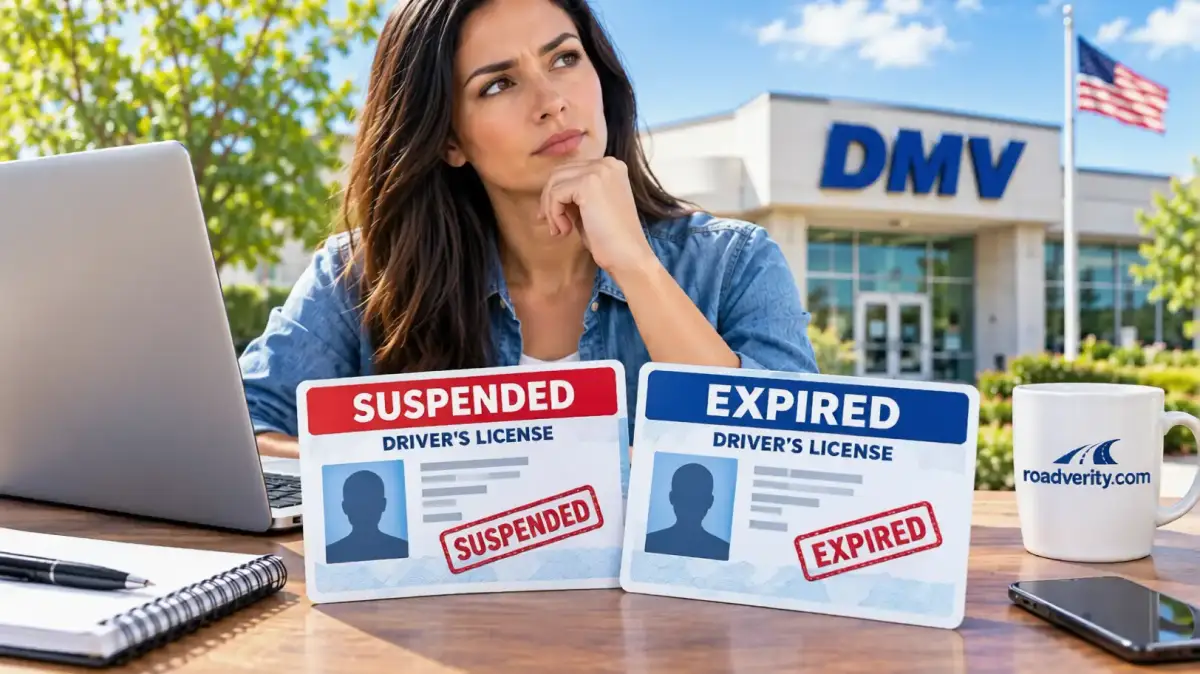
Both mean you can't legally drive right now, which is exactly why people mix them up. But a suspension and an expiration happen for entirely different reasons, carry very different legal stakes, and get fixed in completely different ways.
What Makes Them Different
An expired license simply means the renewal date passed — there's no violation behind it, just paperwork and timing. A suspended license means the state actively took your driving privileges away, generally because of a violation, unpaid obligation, or court order. The practical difference shows up clearly in how seriously each is treated: driving on a recently expired license is often just a non-criminal traffic infraction, while driving on a suspended license is a misdemeanor or worse in nearly every state, with real fines and possible jail time.
The Fix Is Completely Different Too
Renewing an expired license is usually straightforward — pay the fee, update anything that's changed, and in many cases you're done. A suspension requires resolving whatever caused it first: paying a reinstatement fee, completing a required program, or waiting out a set period, and only then reinstating. See how to reinstate a suspended license for that process — it isn't something a simple renewal fixes.
How Long Before an Expired License Requires Retesting?
This is where state variation gets genuinely wide. Some states let you renew years later with no retest at all; others require it after just a few months:
- Texas: a written retest is required if your license has been expired more than 6 months.
- Kansas and Maine: retesting kicks in after 1 year expired.
- Tennessee: you can renew up to 2 years after expiration without retesting.
- Maryland: renewal without retesting is allowed up to 2 years after expiration.
- Massachusetts: no retest required for up to 4 years past expiration — though driving during that time is still illegal.
- Virginia and Louisiana: no grace period at all — driving is illegal starting the day after expiration.
The takeaway isn't any single number — it's that "how long can I wait" has genuinely different answers depending on your state, so check directly rather than assuming a friend's experience in a different state applies to you.
The Compound Problem: Expired While Suspended
This one catches people off guard. If your license expires while you're already suspended, you generally can't just renew your way out of it — many states require you to fully resolve the suspension first, and if enough time has passed, that can mean a complete retest (vision, written, and road) rather than a simple renewal, even if you'd otherwise have qualified for a no-retest renewal. If your suspension period is going to outlast your license's expiration date, it's worth contacting your state's motor vehicle agency early to understand exactly what order you need to handle things in.
Does an Expired License Show Up as a Violation on Your Record?
Generally, no — expiration by itself isn't a punitive entry the way a suspension or conviction is. It's simply a status. If you're pulled over while expired and cited for it, that citation could appear on your record, but the expiration itself isn't treated as a violation in the same category as, say, a moving violation that led to points.
Frequently Asked Questions
Can I drive at all with an expired license if I'm within my state's grace period?
Not necessarily — a grace period for penalty-free renewal isn't automatically the same as permission to legally drive during that window. Check your specific state's rules rather than assuming a grace period means you're covered to drive.
If my license is suspended, does the clock on my expiration date keep running?
Generally, yes — a suspension doesn't pause your license's expiration date. This is exactly how the compound problem above happens.
Does an out-of-state move affect whether my license counts as expired or suspended?
It can complicate things, but it doesn't change what either term means. See requesting an out-of-state driving record if you need documentation from where you used to live.
Will a DMV clerk tell me over the phone whether I'm suspended or just expired?
Often, yes, for a basic status check — see how to check if your license is suspended for the fastest ways to confirm this yourself.
Sources & Methodology
Compiled from official state motor vehicle agency renewal policies and multi-state comparison sources:
Grace periods and retest thresholds are set independently by each state and change periodically. The state examples above illustrate how much this varies rather than covering all 50 states exhaustively — confirm your own state's specific renewal rules with its motor vehicle agency before assuming a timeline.
This article is for general educational purposes only and isn't legal advice. For guidance on your specific situation, contact your state's motor vehicle agency directly.
Next step: If you're dealing with an actual suspension rather than expiration, it helps to know whether it came from the DMV or from a court — the fix can differ. See Administrative vs. Court-Ordered License Suspensions Explained.


Leave a Reply