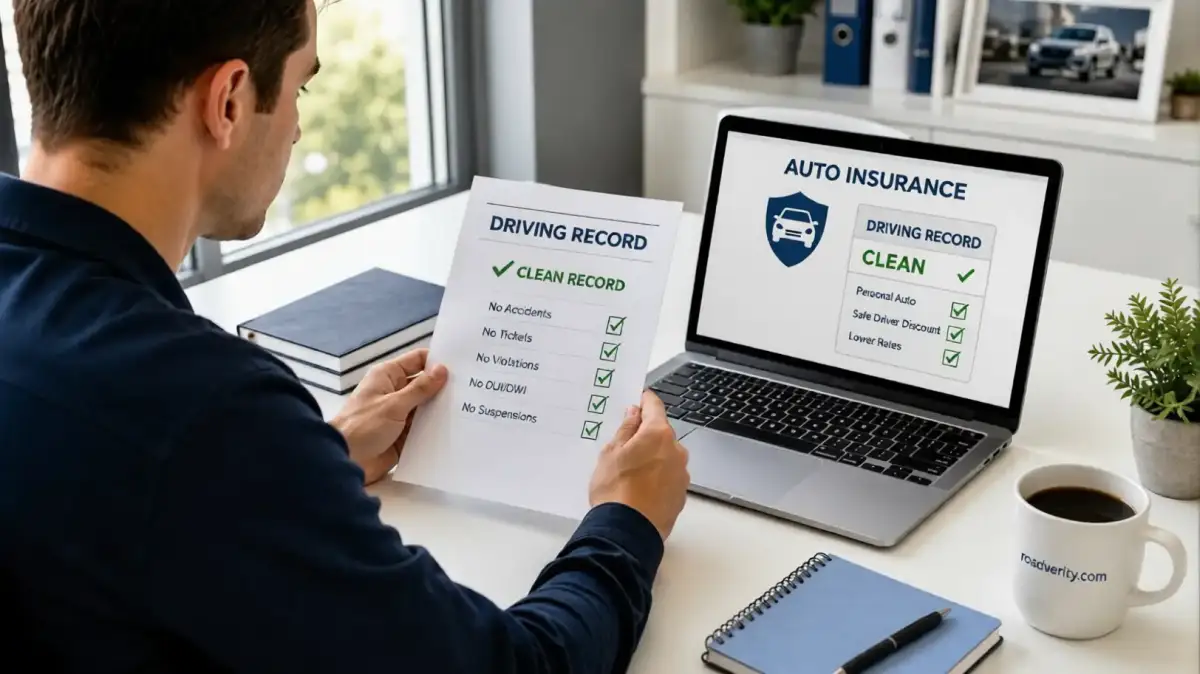
"Clean driving record" isn't an official DMV term — you won't find it stamped on any state's report. It's a working definition insurers and employers use, and while there's broad agreement on the basics, the exact line moves depending on who's asking.
The General Definition
Across the industry, "clean" generally means no moving violations, no at-fault accidents, and no major offenses — DUI/DWI, reckless driving, a suspension — within a defined lookback window. That window typically runs three to five years, though it varies by state and by whoever's evaluating the record.
What Doesn't Count Against a "Clean" Record
- Parking tickets. These are non-moving violations and generally don't appear on your driving record or affect how "clean" it's considered at all.
- Equipment violations — a broken taillight, expired registration — typically don't count against you either, especially if you corrected the issue.
- Accidents that weren't your fault. These may still appear as an entry on your record, but they generally aren't held against you the way an at-fault accident is.
- Old violations that have aged out of whoever's specific lookback window, even if they're technically still visible further back on the full record.
Why "Clean" Depends on Who's Asking
The DMV and your insurer aren't necessarily looking at the same thing. The DMV tracks points toward license suspension under its own state-specific system. Insurers run their own separate internal risk scoring, and a violation can still affect your rate even after it stops counting toward your DMV point total — completing a defensive driving course might clear points with the state, for example, without erasing how an insurer weighs the underlying violation. The two systems overlap but don't move in lockstep.
Employers add a third layer, especially for driving-related roles. A company hiring for a delivery or rideshare position may apply its own stricter standard — sometimes disqualifying a candidate for a single DUI or a pattern of violations that an insurer would consider recoverable within a few years. There's no universal cutoff; it's whatever that specific employer's policy sets.
The DMV Doesn't Use This Term
Your official state record won't say "clean" anywhere on it. What it shows instead is your actual violation and accident history, your license status, and — in states with a point system — your current point total. "Clean" is an interpretation applied on top of that raw data, not a status the state itself assigns. If you want to know exactly where you stand with your state directly, checking your point total and status is the more precise question to ask than whether your record counts as "clean."
How Long Does It Take to Get Back to "Clean"?
This follows the same lookback logic as the definition itself. A single speeding ticket commonly stops affecting how a record is viewed after around three years; an at-fault accident, three to five years; a DUI or other serious offense can affect how a record is viewed for a decade or longer, and in some states can remain part of the permanent record even after it stops being weighted as heavily. The clock resets with every new violation, which is why one ticket rarely does lasting damage on its own, but a pattern within a short window does.
Frequently Asked Questions
If I take a defensive driving course, does that make my record clean again?
It depends on the purpose. In states that allow point reduction, it can clear points with the DMV — but it doesn't erase the underlying violation from your history, and an insurer may still see and weigh it.
Does a warning (not a ticket) affect whether my record is clean?
Generally no — a verbal or written warning that didn't result in a citation typically doesn't appear on your driving record at all.
Can I ask my insurer exactly what they consider "clean"?
Yes, and it's a reasonable question to ask directly, since the answer genuinely varies by company and isn't standardized the way DMV point systems are.
Is a "clean" record the same as having zero violations ever?
No — it usually means nothing within the relevant lookback window, not a lifetime guarantee. An old, aged-out violation from many years ago typically doesn't prevent a record from being considered clean today.
Sources & Methodology
This guide synthesizes patterns consistent across multiple insurance-industry and driving-record references rather than any single company's specific policy, since exact definitions vary by insurer and aren't standardized. General lookback timeframes and what typically counts (or doesn't) reflect common practice as reported across these sources, current as of publication. For your specific situation, your own insurer or employer's stated policy is the authoritative answer, not this general guide.
This article is for general educational purposes only and isn't financial, insurance, or legal advice. For guidance on your specific situation, consult your insurer, employer, or a licensed professional directly.
Next step: Trying to get back to a cleaner record faster than waiting it out? See Can You Expunge or Seal a Driving Record?


Leave a Reply