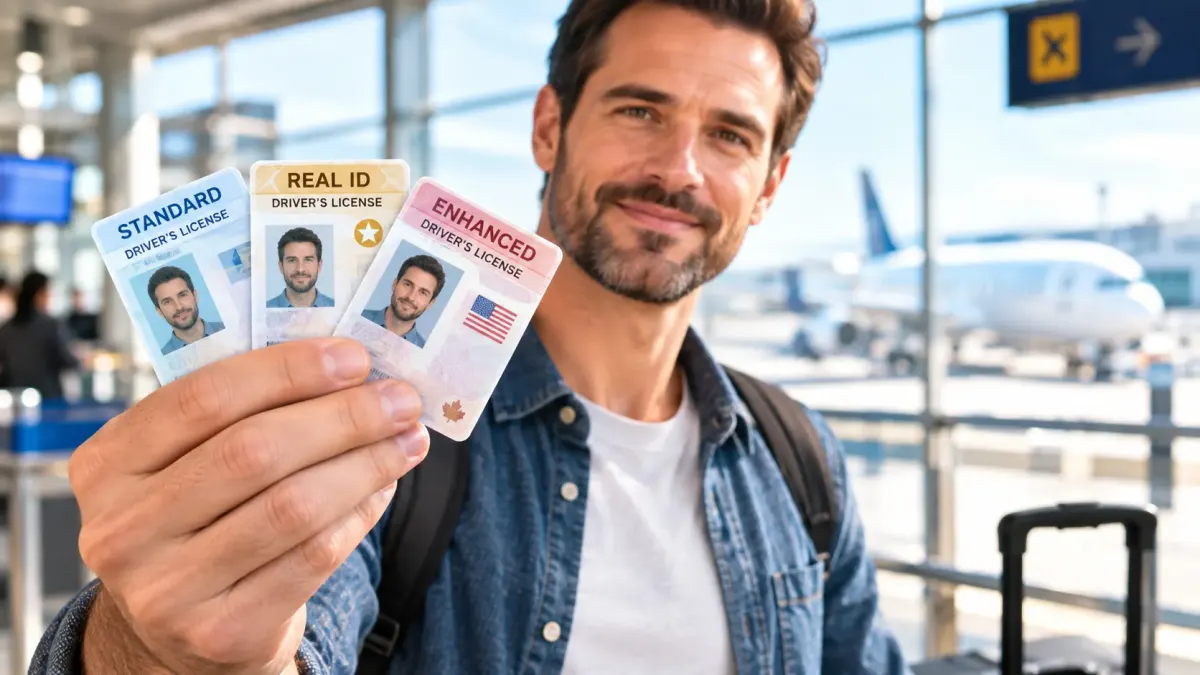
Since federal enforcement began on May 7, 2025, this distinction stopped being theoretical for a lot of people at airport security. Here's exactly what separates the three, and what to do if you're not sure which one you have.
Standard License
A standard license or ID remains fully valid for driving and most everyday purposes — cashing checks, renting a car, purchasing alcohol, and other typical uses. What it no longer covers, as of the May 2025 enforcement date, is boarding a domestic flight or entering certain federal facilities without an additional accepted document like a passport. Many states have marked standard cards with "Federal Limits Apply" since well before enforcement began, specifically to flag this.
REAL ID
A REAL ID-compliant card meets the federal security standard established by the REAL ID Act and is marked with a star in the upper portion of the card — though the exact design varies: most states use a simple gold or black star, some place it inside a circle, and a few use a state-specific icon instead. All 50 states, DC, and the territories are now REAL ID compliant, meaning you can get one at your state's motor vehicle agency. A REAL ID lets you board domestic flights and access the federal facilities that require it.
Enhanced Driver's License (EDL)
This is the one most people haven't heard of, mainly because it's only available in five states: Washington, Michigan, Minnesota, New York, and Vermont. An EDL is automatically accepted for the same federal purposes as a REAL ID, but it does two additional things a standard REAL ID doesn't: it confirms U.S. citizenship specifically (so it isn't available to non-citizens even if they otherwise qualify for a REAL ID), and it works as a land or sea border-crossing document for re-entry from Canada, Mexico, Bermuda, and parts of the Caribbean — without needing a passport for those specific crossings. Most EDLs carry a flag marking instead of a star, though the exact design still varies by state.
Quick Comparison
| Standard | REAL ID | Enhanced (EDL) | |
|---|---|---|---|
| Valid for driving | Yes | Yes | Yes |
| Board domestic flights | No | Yes | Yes |
| Access restricted federal facilities | No | Yes | Yes |
| Land/sea border re-entry without a passport | No | No | Yes |
| Confirms citizenship | No | No | Yes |
| Available in | All states | All states | WA, MI, MN, NY, VT only |
What If You Have Neither and Need to Fly?
You're not necessarily stuck. A valid passport works in place of REAL ID at airport security. Beyond that, TSA introduced a paid alternative identity verification option, ConfirmID, for travelers without an acceptable ID at the checkpoint — it costs $45 per use. It's a real option in a pinch, but getting a REAL ID or renewing your passport ahead of travel is the more practical long-term fix if you fly with any regularity.
You Don't Need REAL ID for Everything
It's easy to assume you need the upgraded version for anything official. You don't — accessing health or life-preserving services like hospitals, interacting with law enforcement, and constitutionally protected activities like a defendant's access to court proceedings are all specifically exempted. REAL ID is about a fairly narrow set of federal purposes, not a general requirement for interacting with government services.
What It Costs to Upgrade
If you convert to REAL ID at your regular renewal, most states charge no extra fee beyond your normal renewal cost. Converting outside of a renewal typically carries a smaller correction fee — Michigan's example is $9 for a license or $10 for an ID card. An Enhanced license generally costs more on top of that; New York's EDL runs about $30 more than a standard REAL ID. Documentation requirements are more involved than a routine renewal — expect to provide proof of identity and proof of U.S. citizenship or legal presence, and note that document verification can take more than a single business day.
Frequently Asked Questions
How do I know if my current license is already REAL ID compliant?
Check the upper portion of the card for a star (or a flag, if you're in one of the five EDL states) — if it's not there, your card isn't compliant, regardless of how recently it was issued.
Can I still use my standard license to drive across state lines?
Yes — REAL ID compliance only affects specific federal purposes like flying and certain facility access, not driving itself, including across state lines.
Is getting a REAL ID mandatory?
No — it's optional. You only need one if you plan to fly domestically without a passport or need access to a federal facility that requires it.
Does an Enhanced license replace a passport entirely?
No — it's specifically accepted for land and sea border crossings with Canada, Mexico, Bermuda, and parts of the Caribbean, not for international air travel, where a passport is still required.
Sources & Methodology
Compiled directly from federal and state sources:
- Transportation Security Administration — REAL ID FAQs
- New York DMV — Enhanced or REAL ID
- Washington State Department of Licensing — REAL ID
- Michigan Secretary of State — REAL ID
REAL ID and EDL rules are federally standardized in their core requirements, though states vary in card design, fees, and documentation specifics. This guide reflects information current as of publication — confirm your own state's exact requirements and fees with its motor vehicle agency.
This article is for general educational purposes only. For guidance on your specific situation, contact your state's motor vehicle agency or the TSA directly.
Next step: Ready to apply or renew? See What to Bring to the DMV: Complete Appointment Checklist.
Leave a Reply