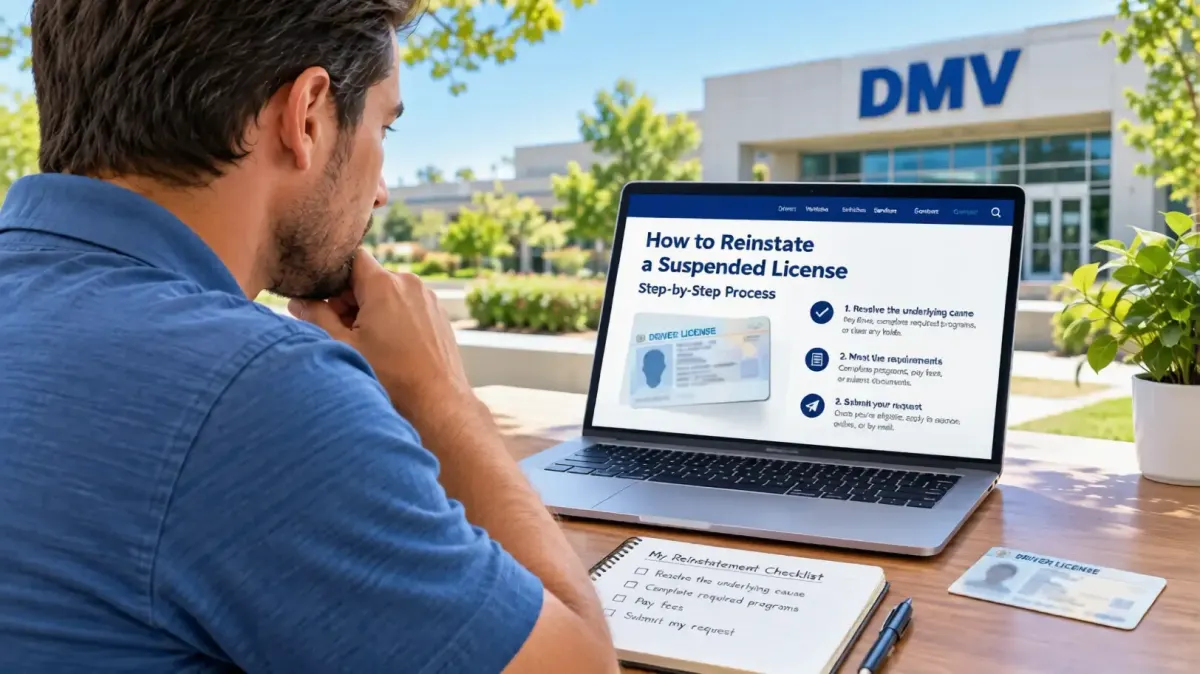
There's no single reinstatement process, because it depends entirely on why you were suspended in the first place — but the general shape is consistent across states. This walks through it step by step. (If you're actually dealing with a revocation rather than a suspension, the path is different — see suspension vs. revocation vs. cancellation first.)
Step 1: Identify Exactly Why You Were Suspended
This determines everything that follows, and it's worth confirming directly rather than assuming — see how to check if your license is suspended if you haven't already. Common causes include unpaid fines, a DUI or other court-ordered action, too many points, a lapse in required insurance, or a medical review — and each one leads down a different specific path from here.
Step 2: Resolve the Underlying Issue
Whatever caused the suspension has to actually be resolved before reinstatement is possible — this isn't optional or something a reinstatement fee alone can skip past. That might mean paying outstanding fines or court fees, satisfying a court judgment, providing proof of current insurance, or simply waiting out a mandatory minimum period if that's all your specific suspension requires.
Step 3: Complete Any Required Programs
Depending on the cause, you may need to complete a defensive driving course, a drug or alcohol education program, or — for DUI-related suspensions in some states — provide proof of SR-22 or FR-44 insurance. Maryland, for example, requires a 12-hour Alcohol Education Program for alcohol-related incidents regardless of how long ago it happened. Check your specific state's requirements rather than assuming a program from a different state's process applies.
Step 4: Pay the Reinstatement Fee
This is separate from any court fines or program costs, and it varies by state — Colorado's is $95, as a real example, though every state sets its own. See reinstatement fees by state for a fuller comparison once that's available.
Step 5: Submit Your Reinstatement Request
Once every prior condition is met, you submit the actual reinstatement request — commonly online, though some states still require mail or an in-person visit depending on the type of suspension. Georgia's system is a good example of how personalized this can get: rather than one generic checklist, its online system generates step-by-step requirements specific to your own record, since the exact combination of what applies to you varies too much for a single universal list.
Step 6: Wait for Confirmation
Processing isn't always instant. Colorado, for example, mails a "letter of clearance" once every requirement is confirmed met, and recommends submitting your reinstatement paperwork around 30 days before your actual eligibility date so it's ready to process right when you become eligible. Other states notify by mail or through an online account.
A Trap Worth Watching For
If your license's own expiration date passed while you were suspended, some states — Maryland among them — specifically flag this: if it's been expired more than a year during the suspension period, you may need to fully reapply and retest rather than simply reinstate. This is the same compound issue covered in suspended vs. expired license — worth checking early rather than discovering it at the end of the process.
If Another State Is Involved
If your suspension involves a violation or action from a different state, some states — Tennessee is a documented example — require you to get cleared with that other state first and submit a motor vehicle report specifically showing that clearance, alongside your own state's paperwork. See requesting an out-of-state driving record for how to get that documentation.
Frequently Asked Questions
How long does the whole process typically take?
It depends heavily on how many separate conditions you need to satisfy and how quickly you complete them — some straightforward cases resolve in weeks, while multi-part cases (court requirements plus a program plus an insurance filing) can take considerably longer.
Can I start the reinstatement paperwork before I've technically become eligible?
In some states, yes — submitting shortly before your eligibility date, so it's ready to process, is explicitly recommended by at least one state's own process. Check whether your state allows this rather than assuming.
What if I have more than one suspension on my record at the same time?
Most states require resolving all outstanding suspensions, not just the one you're focused on, before reinstating any of them.
Do I get a new physical license, or does my old one become valid again?
This varies — some states reactivate your existing license, others issue a new one as part of the reinstatement process.
Sources & Methodology
Compiled from official state motor vehicle agency reinstatement procedures:
- Colorado DMV — Process to Reinstate Driving Privilege
- Maryland MVA — Reinstate a License
- Georgia DDS — Reinstate License
- Tennessee Department of Safety — Reinstatements
Reinstatement requirements, fees, and submission methods vary significantly by state and by the specific reason for suspension. The states shown here illustrate the general process, not a universal standard. This guide reflects information current as of publication — confirm your own state's specific requirements with its motor vehicle agency.
This article is for general educational purposes only and isn't legal advice. For guidance on your specific situation, contact your state's motor vehicle agency directly.
Next step: Want to know exactly what paperwork to gather before you start? See Required Documents for License Reinstatement (Checklist).