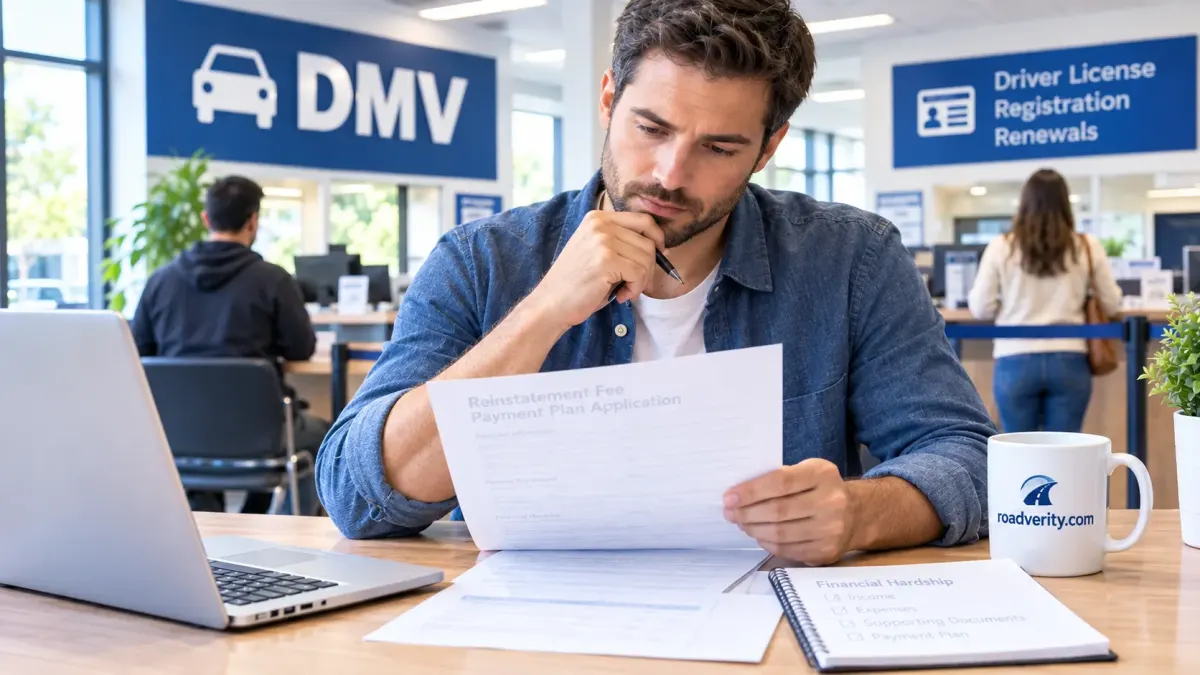
If the reinstatement fee itself is what's standing between you and a valid license, several states let you pay it in installments rather than all at once — and one state even lets you drive while you do it. This covers the DMV-level fee specifically; court fines are a separate matter, covered near the end.
Do You Qualify?
The pattern across states that offer this is fairly consistent: you generally need to owe above a minimum threshold, have already satisfied every other reinstatement requirement (insurance proof, required courses, and so on — the payment plan only addresses the fee itself), and make an initial down payment to enroll. Some states also disqualify you if you're already on a court-ordered payment plan for the same debt, since that one typically takes priority.
Real Examples of How These Work
- Ohio: available if you owe at least $150 in reinstatement fees and have met every other requirement. A $25 initial payment is required with the application, and the plan carries no interest.
- Tennessee: available for balances over $75. A $25 administrative down payment starts it, then $75 every quarter until paid off — over as long as 60 months if needed. If you get suspended again while on the plan, you can modify it to include the new fees rather than starting over.
- Virginia: specifically for uninsured-motorist suspensions, where the fee itself can be substantial ($600 per suspension order, plus the reinstatement fee). Minimum $25 a month per vehicle, paid off within three years — though proof of insurance still has to stay on file for three years regardless of whether you pay off the balance sooner.
- South Carolina: a $40 administrative fee plus a 10% deposit gets you enrolled, with the balance due within 12 months.
South Carolina's Unique Approach: You Can Actually Drive While Paying
This is worth calling out specifically. Most payment plans just spread out what you owe while you're still not legally driving until it's paid off. South Carolina's program is different: once enrolled, you receive an actual valid license — a restricted "Payment Plan" license — that lets you legally drive during the 12-month payment period, rather than waiting until the full balance clears. If you're weighing whether a payment plan is worth pursuing versus simply saving up and paying in full, this kind of program changes that calculation significantly if your state offers something similar.
What Happens If You Default
This varies a lot by state, and it's worth understanding before you commit to a plan rather than after you miss a payment:
- Some states, like Tennessee, allow you to re-enter a new plan for the defaulted balance rather than losing everything you've paid.
- Virginia allows up to two defaults on the same agreement before you're no longer eligible to continue it.
- South Carolina is stricter: if your Payment Plan license itself gets suspended for any reason, it can't be reinstated, the plan ends, and all remaining suspensions reactivate — with no refund of what you've already paid.
Know your specific state's default policy before enrolling, since "what happens if I miss a payment" genuinely isn't the same answer everywhere.
What About True Hardship Waivers?
It's worth being precise about the difference between a payment plan (you still pay the full amount, just over time) and an actual waiver (the fee is reduced or forgiven). What we found consistent, well-documented evidence for across states is payment plans — genuine fee forgiveness specifically for the DMV reinstatement fee is far less commonly available. Where hardship relief does show up more often is at the court level, for the underlying fines and surcharges rather than the DMV's own fee — some courts offer indigency waivers for those specific costs if you qualify, which is a separate process from the DMV's payment plan and handled by the court, not the motor vehicle agency.
Frequently Asked Questions
Does a payment plan reinstate my license immediately, or only once it's fully paid?
This depends entirely on your state. Some, like South Carolina, issue a valid (if restricted) license as soon as you enroll. Others require the full balance before driving privileges return — check your specific state's program rather than assuming either way.
Can I set up a payment plan online?
Some states allow this; others require mail or an in-person application. Virginia, for example, offers both online and in-person enrollment.
Does interest accrue on the unpaid balance?
Not necessarily — Ohio's program, for example, explicitly charges no interest. Confirm this specifically for your state, since it isn't universal.
What if I owe fees in more than one state?
Payment plans are generally state-specific — enrolling in one state's plan doesn't address a balance owed to a different state. See requesting an out-of-state driving record if another state's history is part of your situation.
Sources & Methodology
Compiled from official state motor vehicle agency payment plan programs:
- Ohio BMV — Fee Installment Plan Application
- Tennessee Department of Safety — Payment Plan for Reinstatement Fees
- Virginia DMV — Payment Plan Program
- South Carolina DMV — Payment Plan Eligibility
Not every state offers a reinstatement fee payment plan, and program details, thresholds, and default policies vary significantly among those that do. This guide reflects information current as of publication — confirm whether your own state offers a program, and its specific terms, with its motor vehicle agency.
This article is for general educational purposes only and isn't legal or financial advice. For guidance on your specific situation, contact your state's motor vehicle agency directly.
Next step: Whether you're paying in full or through a plan, it helps to know what to expect timeline-wise. See How Long Does License Reinstatement Take? Timelines & Delays.